
Dispatch notes
Storm days without soggy cartons
Summer storms on the Highveld land almost on schedule. A few habits at the depot door keep cartons dry, drivers safe and receivers calm when the sky opens at three.
On the team
Check the afternoon forecast at the morning huddle, not at two oclock. Storm days without soggy cartons is the short list we hand to new dispatch leads in October.
Why storms catch small teams out
From October to March most of Gauteng, the Free State and inland KZN get an afternoon thunderstorm on more days than not. It usually arrives between two and five, right when the second run is loading and the first drivers are coming back. A big depot has a covered dock and a person whose only job is the yard. A small team has one roller door, a canopy that covers half a van and an ops lead who is also answering the phone.
The damage is rarely dramatic. It is a carton that sat on wet paving for two minutes, a label that smudged and will not scan, or a box that looks fine until the receiver lifts it and the bottom gives. Those are the returns that hurt, because the customer sees them as carelessness and not weather.
Before lunch: stage and wrap
On a storm day the afternoon run should be staged before lunch. Pull the cartons for the second loop, build them on a pallet just inside the door and stretch wrap the whole stack. Wrap the bottom row twice, since that is where splash from the floor gets in. Labels go on the top face and the side facing the driver, and on paper cartons we put a strip of clear tape over the barcode so it still reads after a wet handover.
- Second run cartons staged and wrapped by 12:30
- Barcodes taped on any carton that will travel after 14:00
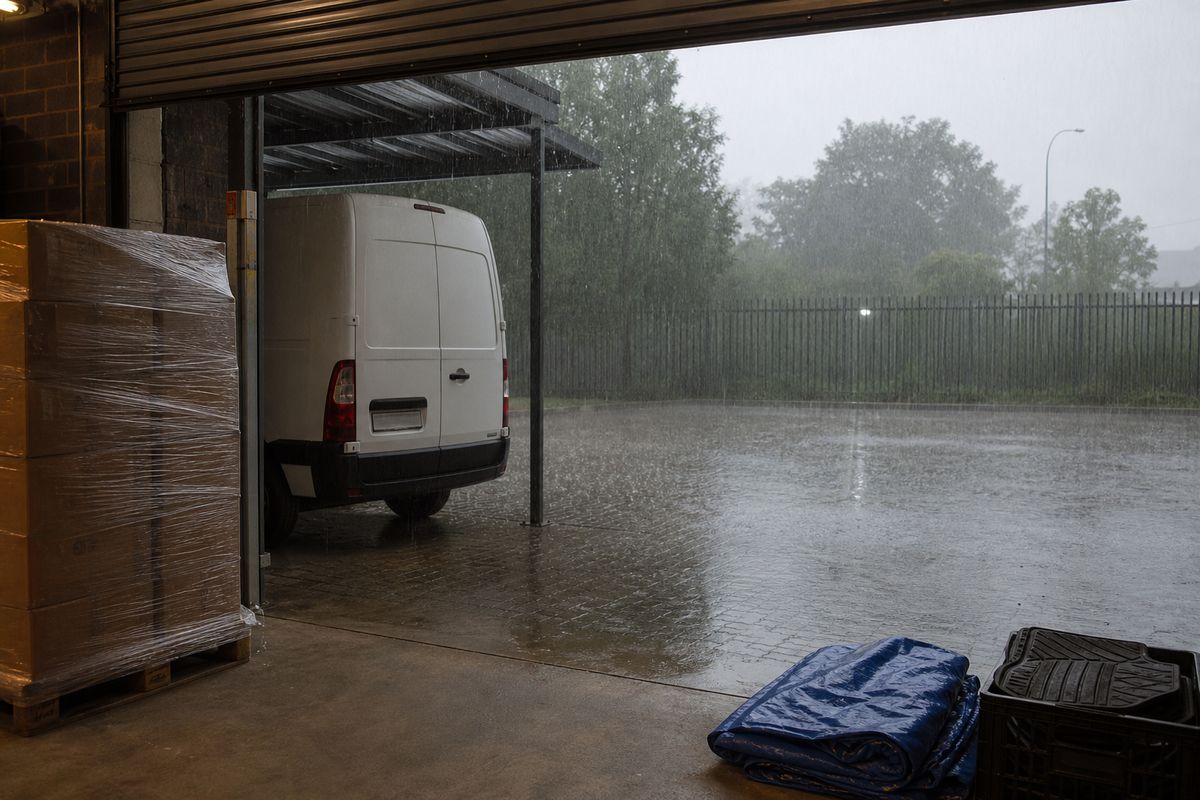
- Tarp and a crate of rubber mats at the door, not in the store room
- Van backed in under the canopy before loading starts
None of this takes long. Its the kind of thing that only gets skipped when nobody decided in the morning that today is a storm day.
Moving the window, not just the van
If the forecast shows a storm at three, an afternoon band of 14:00 to 17:00 is a promise you probably can not keep. Move it before the customer asks. For most of our lanes we shift the second loop to 12:00 to 15:00 on storm days, or we hold it to the next morning for anything fragile or paper heavy. The message goes out with the morning update, the same way we describe in Windows before WhatsApp, so receivers are not surprised.
Estates and office parks matter here too. Many guardhouses do not let a van wait on the road during lightning, and some loading bays close when the yard floods. Note those sites on the lane card so the driver knows which stops to do first and which can safely slide.
At the door when it is already raining
Sometimes the storm comes early anyway. Our rule is simple: no carton crosses open ground in heavy rain. The driver waits under cover for the worst of it, which is usually ten or fifteen minutes, and tells the receiver with a short status line. We keep it to the three status lines everyone already knows, so the message is calm and not a long apology.
If a carton does get wet, the driver takes a photo before handover and notes it on the exception log, with no blame on anyone. Our exception log note covers how we word it. The receiver can then decide to accept or refuse while the driver is still there, which is far easier then a call two days later.
After the storm
When the run is done, the ops lead spends five minutes on a quick review. Which stops slipped, which cartons got wet, and did the moved window hold. Over one season this builds a picture of which lanes need a morning slot from November onwards. Teams that also deal with power cuts on storm days can pair this with Soft moves when power fails, since the two often arrive together.
If you want a printable storm day card for your own door, have a look at our checklists or tell us about your lanes through the contact form and the team will help you set one up.